Sun & planets · Space Codex

Uranus

Tilted 97.8°, Uranus rolls around the Sun on its side, giving each pole about 42 years of continuous daylight.

Ice giant tipped on its side
  • Last reviewed 10 Oct 2026
  • 6 sources
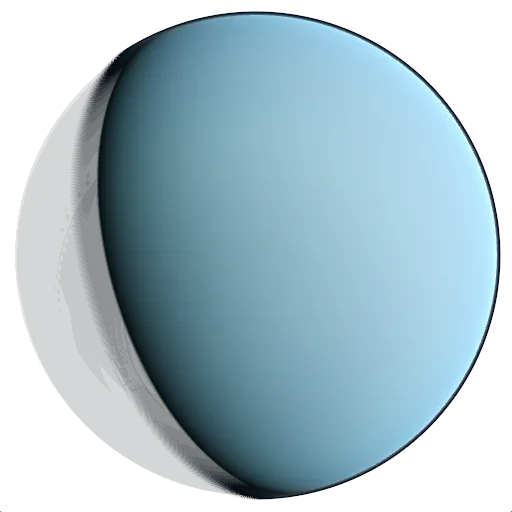
Uranus as drawn by our real-time 3D model
Still rendered from our real-time 3D model. Surface colour from NASA imagery via Solar System Scope (CC BY 4.0).

At a glance

Uranus at a glance, with sources
MeasureValueSource
Mean radius25,362 km (4.0 Earth)JPL Solar System Dynamics: planetary physical parameters (opens in a new tab)JPL Solar System Dynamics: planetary physical parameters (opens in a new tab)
Mass8.681 × 10²⁵ kg (14.5 Earth)JPL Solar System Dynamics: planetary physical parameters (opens in a new tab)JPL Solar System Dynamics: planetary physical parameters (opens in a new tab)
Mean density1.27 g/cm³JPL Solar System Dynamics: planetary physical parameters (opens in a new tab)JPL Solar System Dynamics: planetary physical parameters (opens in a new tab)
Equatorial gravity8.87 m/s²JPL Solar System Dynamics: planetary physical parameters (opens in a new tab)JPL Solar System Dynamics: planetary physical parameters (opens in a new tab)
Escape velocity21.38 km/sJPL Solar System Dynamics: planetary physical parameters (opens in a new tab)JPL Solar System Dynamics: planetary physical parameters (opens in a new tab)
Rotation17 h 14 min 52 s, retrogradeMeasured from Hubble aurora tracking (2025); 28 s longer than the Voyager 2 value.NASA Science: Hubble measures Uranus's rotation (opens in a new tab)NASA Science: Hubble measures Uranus's rotation (opens in a new tab)
Year84.0 Earth yearsJPL Solar System Dynamics: planetary physical parameters (opens in a new tab)JPL Solar System Dynamics: planetary physical parameters (opens in a new tab)
Mean distance from Sun19.19 AU (2.87 billion km)NASA NSSDC Planetary Fact Sheet (opens in a new tab)NASA NSSDC Planetary Fact Sheet (opens in a new tab)
Sunlight travel time2 h 40 minNASA NSSDC Planetary Fact Sheet (opens in a new tab)NASA NSSDC Planetary Fact Sheet (opens in a new tab)
Axial tilt97.77°NASA NSSDC Uranus Fact Sheet (opens in a new tab)NASA NSSDC Uranus Fact Sheet (opens in a new tab)
Temperature at 1 bar−197 °C (76 K)NASA NSSDC Uranus Fact Sheet (opens in a new tab)NASA NSSDC Uranus Fact Sheet (opens in a new tab)
Coldest measured49 K (−224 °C)NASA Science: Uranus facts (opens in a new tab)NASA Science: Uranus facts (opens in a new tab)
AtmosphereH₂ 82.5%, He 15.2%, CH₄ 2.3%NASA NSSDC Uranus Fact Sheet (opens in a new tab)NASA NSSDC Uranus Fact Sheet (opens in a new tab)
Bond albedo0.30NASA NSSDC Uranus Fact Sheet (opens in a new tab)NASA NSSDC Uranus Fact Sheet (opens in a new tab)
Magnetic fieldTilted 58.6° from the spin axis, offset by 0.35 radiiNASA NSSDC Uranus Fact Sheet (opens in a new tab)NASA NSSDC Uranus Fact Sheet (opens in a new tab)
Moons29 officially recognisedas of Aug 2026The 29th, S/2025 U1, was found by JWST in Feb 2025 images.NASA Science: Uranus moons (opens in a new tab)NASA Science: Uranus moons (opens in a new tab)
Rings13 faint ringsNASA Science: Uranus facts (opens in a new tab)NASA Science: Uranus facts (opens in a new tab)

Key points

It has the coldest atmosphere measured on any planet.

  • Rolls around the Sun on its side (97.8° tilt)
  • Coldest planetary atmosphere measured: 49 K
  • Its day was re-measured in 2025: 17 h 14 min 52 s

Interior

More than 80% of Uranus's mass is a hot, dense fluid of water, methane and ammonia above a small rocky core, where temperatures approach 5,000 °C. Unlike the other giants, Uranus releases almost no internal heat, one reason its upper atmosphere is the coldest of any planet.

Atmosphere and seasons

Methane absorbs red light and gives the planet its pale cyan colour. Because of the tilt, each pole spends about 42 years in sunlight followed by 42 years of darkness, and the atmosphere responds with slow, dramatic seasonal changes.

Rings and moons

Thirteen narrow, dark rings circle the planet. Its five major moons, Miranda, Ariel, Umbriel, Titania and Oberon, are named, like most Uranian moons, after characters from Shakespeare and Alexander Pope.

Exploration

Voyager 2's flyby in January 1986 is still the only visit. A Uranus orbiter and probe was the top flagship priority of the 2023 US planetary decadal survey but has not been approved as a mission.

What we still don't know

What knocked Uranus over, why it emits so little heat, and whether any of its large moons hides an ocean.

Moons

The 5 major moons of Uranus in the Codex, each with its own sourced entry.

  • MirandaA patchwork moon with record cliffs
  • ArielUranus's youngest, brightest face
  • UmbrielThe darkest of Uranus's large moons
  • TitaniaUranus's largest moon
  • OberonThe outermost major moon of Uranus

Missions

  1. 1977–

    Voyager 2

    NASAActive

    The only spacecraft to visit Uranus (1986) and Neptune (1989); interstellar since 5 Nov 2018.

    Mission page (opens in a new tab)

First-hand · our 3D model

How we render it

Uranus is tilted 97.8°, so it rolls along its orbit on its side, and everything follows that tilt: its narrow rings and its five major moons orbit in the tilted equatorial plane. The rings are drawn as five thin bands, with the outermost epsilon ring the brightest. A deep Rayleigh-blue haze shell sits over the methane cloud deck, and the globe is slightly flattened (polar radius 0.977 of equatorial).

Sizes and distances in the model are not to scale, so every world can be seen up close. Colour maps are derived from NASA mission imagery via Solar System Scope (CC BY 4.0). The first frame uses light startup maps; higher-resolution maps stream in after the scene is on screen, decoded off the main thread so the page stays responsive.

  • MirandaA patchwork moon with record cliffs
  • TitaniaUranus's largest moon
  • Voyager 2The only visitor to Uranus and Neptune

Sources

  1. JPL Solar System Dynamics: planetary physical parameters (opens in a new tab)
  2. NASA Science: Hubble measures Uranus's rotation (opens in a new tab)
  3. NASA NSSDC Planetary Fact Sheet (opens in a new tab)
  4. NASA NSSDC Uranus Fact Sheet (opens in a new tab)
  5. NASA Science: Uranus facts (opens in a new tab)
  6. NASA Science: Uranus moons (opens in a new tab)

Last reviewed against these sources. Built from public NASA, ESA and JPL data; not affiliated with or endorsed by any agency.