Sun & planets · Space Codex
Venus
Nearly Earth's size, but buried under a CO₂ atmosphere 92 times as heavy, with sulfuric-acid clouds and a 464 °C surface: hotter than Mercury.
Runaway greenhouse twin of Earth
At a glance
Key points
- A Venus day (243 Earth days) is longer than its year (225 days)
- The Sun rises in the west because Venus spins backward
- Hotter than Mercury despite being twice as far from the Sun
Atmosphere and weather
Standing on Venus would feel like being 900 m underwater. The CO₂ atmosphere traps heat so efficiently that night and day, pole and equator, all sit near 464 °C. Three layers of sulfuric-acid cloud race around the planet in four Earth days, sixty times faster than the surface turns.
Surface
Radar sees through the clouds to plains of basalt, thousands of volcanoes and highland 'continents'. Maxwell Montes in Ishtar Terra rises about 11 km. In 2023 a reanalysis of 1991 Magellan images showed a vent on Maat Mons doubling in size over eight months: the first direct sign of a recent eruption.
Interior
Venus probably has an iron core, rocky mantle and crust like Earth's, but no plate tectonics and no global magnetic field. Its slow rotation may be one reason no dynamo runs.
Exploration
Magellan radar-mapped almost the whole surface in the early 1990s; Venus Express and Akatsuki studied the atmosphere from orbit. ESA's EnVision is planned to launch in 2031. NASA lists VERITAS and DAVINCI as future missions without confirmed launch dates.
What we still don't know
How active its volcanoes are today, whether Venus once had oceans before its greenhouse ran away, and why its atmosphere super-rotates.
Missions
- 1989–1994
Magellan
NASACompletedRadar-mapped almost the entire surface through the clouds.
- 2005–2014
Venus Express
ESACompletedLong-term study of the atmosphere and its super-rotation.
- 2010–2024
Akatsuki
JAXACompletedOrbited Venus from 2015 to study its weather; contact was lost in 2024.
- Launch planned 2031
EnVision
ESAPlannedAdopted Jan 2024; radar and spectrometers to trace Venus's geological history.
- Launch date not set
VERITAS
NASAPlannedRadar mapping orbiter; NASA lists it as a future mission without a confirmed launch date.
- Launch date not set
DAVINCI
NASAPlannedAtmospheric descent probe; listed as a future mission without a confirmed launch date.
First-hand · our 3D model
How we render it
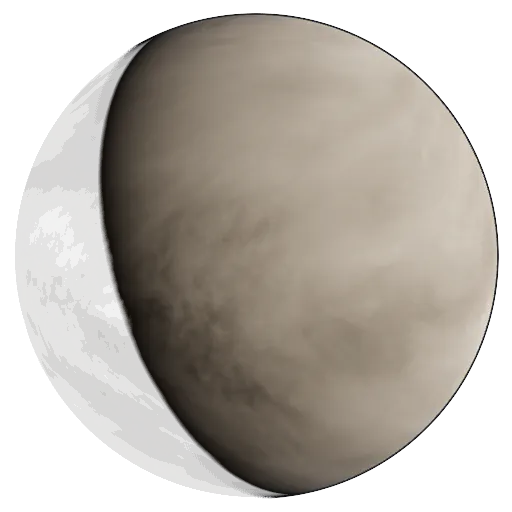
What you see on Venus is the cloud deck, not the ground: the colour map is a map of the cloud tops. Above it, a ray-marched single-scattering shell adds the bright sulfuric-acid haze, using a strongly forward-scattering Mie phase function so the day-side limb glows. The globe is tilted 177.4°, which is how the model encodes Venus's backwards spin.
Sizes and distances in the model are not to scale, so every world can be seen up close. Colour maps are derived from NASA mission imagery via Solar System Scope (CC BY 4.0). The first frame uses light startup maps; higher-resolution maps stream in after the scene is on screen, decoded off the main thread so the page stays responsive.
Sources
- JPL Solar System Dynamics: planetary physical parameters (opens in a new tab)
- NASA NSSDC Venus Fact Sheet (opens in a new tab)
- NASA NSSDC Planetary Fact Sheet (opens in a new tab)
- NASA Science: Venus facts (opens in a new tab)
Last reviewed against these sources. Built from public NASA, ESA and JPL data; not affiliated with or endorsed by any agency.