
Exoplanets · Space Codex
TRAPPIST-1
A cool red dwarf barely larger than Jupiter, circled by seven rocky planets packed inside a distance smaller than Mercury's orbit.
Seven Earth-sized worlds · about 40.5 light-years
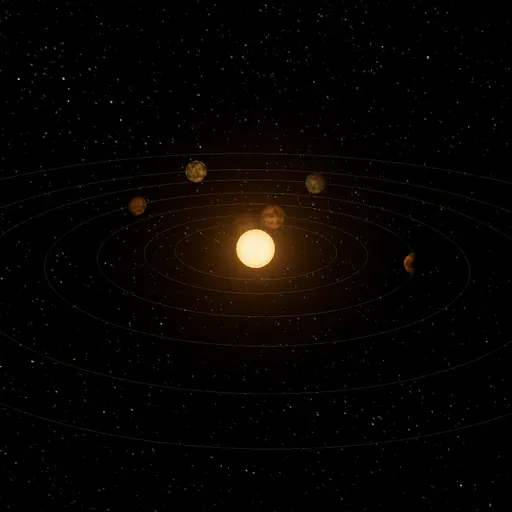
Artist's concept. No telescope has seen TRAPPIST-1 as more than a point of light, and most exoplanets not even that. What we know comes from how a planet dims or tugs its star. Any picture of its surface, colour or sky, anywhere, is an illustration, not an observation.
At a glance
Key points
JWST has shown the two innermost lack thick atmospheres.
- About 40.5 light-years away
- Seven rocky planets inside a Mercury-sized orbit
- JWST: the two innermost planets lack thick atmospheres
A compact chain
All seven orbits would fit inside Mercury's. The planets are linked in a chain of near-resonances: for every 8 orbits of b, c makes 5, d makes 3, and so on outward. Their mutual tugs shift transit times by minutes, and Agol and colleagues used those shifts to weigh every planet to within a few percent.
What JWST has found
Thermal measurements in 2023 and full phase curves published in 2026 show b's dayside at about 490 K with no heat carried to the night side: a dark, airless rock. c is cooler than a bare dark rock should be, consistent with no air or a thin oxygen-rich one. Transmission spectra rule out hydrogen-rich atmospheres on d, e and f. Whether e, the most Earth-like, has a nitrogen atmosphere is still open.
Living with a red dwarf
The planets are almost certainly tidally locked, with permanent day and night sides. The star flares often, and its ultraviolet and X-ray output may have stripped the inner planets of their air. From e the star would look about four times wider than the Sun from Earth, and the neighbouring planets would show as discs in the sky.
What we still don't know
Whether any of the outer planets kept an atmosphere or water, and how much of each spectrum is really starspot contamination.
About this view
Orbital spacing, periods and the planets' relative sizes are real; the planets are enlarged about 46 times and the star 5 times against their orbits, or they would be invisible. The star's colour is a 2,566 K blackbody. Surfaces are an artist's concept: dark bare rock for b to d, icier toward h.
Missions
- 2021–
Infrared observatory at Sun–Earth L2, about 1.5 million km from Earth.
- 2009–2018
Kepler / K2
NASACompletedTransit survey that showed small planets are common.
First-hand · our 3D model
How we render it
TRAPPIST-1 is shown as a whole system rather than one planet: all seven planets at their true relative orbital spacing, relative sizes and periods. Bodies are enlarged against their orbits, the planets 46 times and the star 5 times, or they would be smaller than a pixel. Time runs at half a day per second, so the innermost planet, b, laps in about 3 seconds and h in about 38; starting positions are illustrative, not an ephemeris.
The 2,566 K star is orange, not blood red, and is drawn with strong limb darkening. Each planet is lit only by it. Planets b to d are dark bare rock, and e to h grow progressively icier, with ice gathering on the night side, away from the point facing the star.
No telescope has imaged the surface of any planet shown here, so what you see is an artist's concept: the surface is generated by a shader from noise, not drawn from a map, and its colours and features are illustrative. What is tied to measurement is the starlight and the geometry. The host star's colour is a blackbody at its catalogued temperature, and the planet is tidally locked, with a fixed day side facing the star and a permanent night side.
Related entries
- Exoplanets: the censusPlanets around other stars
- James Webb Space TelescopeInfrared observatory at L2
- Proxima Centauri bThe nearest exoplanet · 4.24 light-years
Sources
- Piaulet-Ghorayeb et al. 2025 (arXiv) (opens in a new tab)
- JWST-TST DREAMS 2025 (arXiv) (opens in a new tab)
- Lim et al. 2026 (arXiv) (opens in a new tab)
- NASA Exoplanet Archive: TRAPPIST-1 overview (opens in a new tab)
- Agol et al. 2021, Planetary Science Journal 2:1 (opens in a new tab)
- Gillon et al. 2026, Nature Astronomy (opens in a new tab)
Last reviewed against these sources. Built from public NASA, ESA and JPL data; not affiliated with or endorsed by any agency.