
Nebulae · Space Codex
Orion Nebula
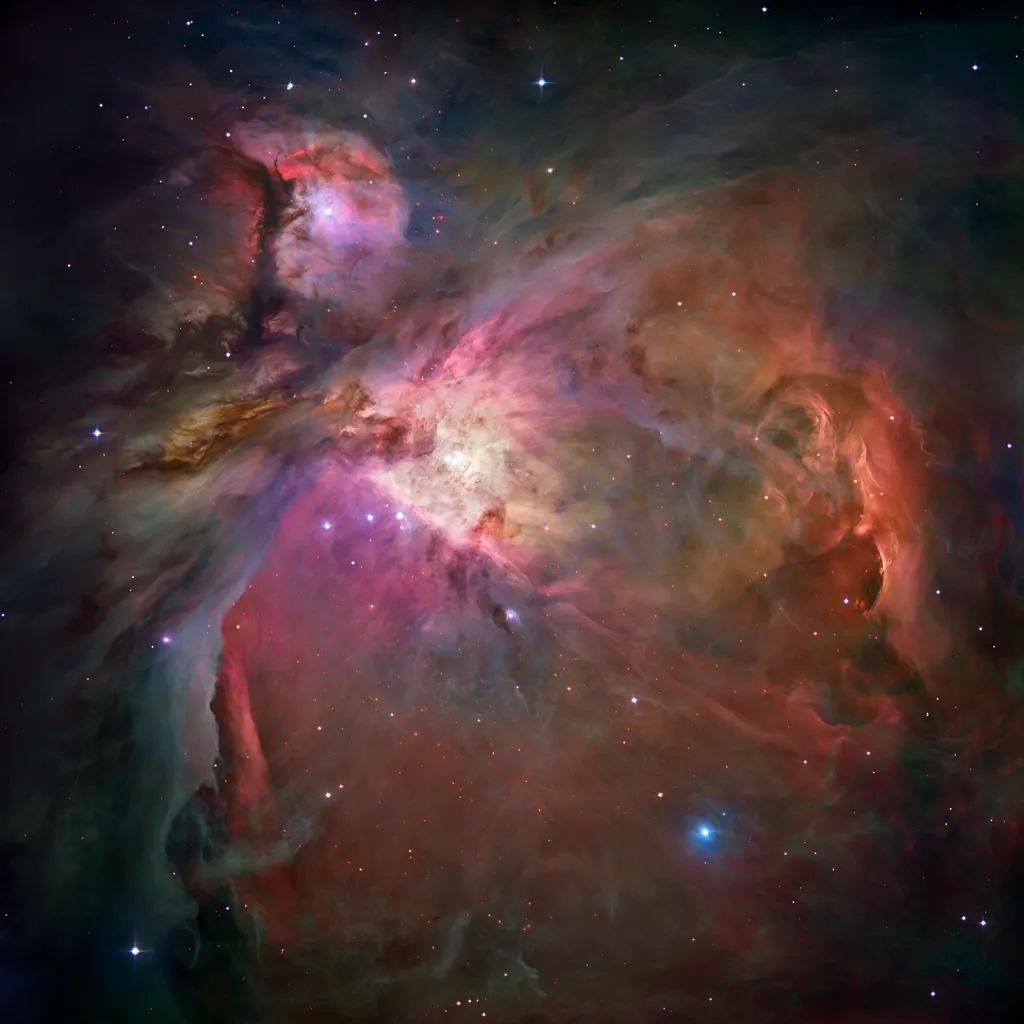
A glowing cloud of gas and dust about 1,300–1,350 light-years away in Orion's sword, lit by a cluster of hot young stars.
M42 · the nearest large stellar nursery
At a glance
Key points
It is the closest region of massive star formation to Earth.
- Visible to the naked eye in Orion's sword
- Closest region of massive star formation
- Hosts hundreds of planet-forming discs
Why it glows
Ultraviolet light from the Trapezium's massive stars strips electrons from hydrogen. As they recombine, the gas emits the deep red of hydrogen-alpha, mixed with the teal of doubly ionised oxygen, giving the nebula its pink-and-green look in true-colour photographs.
A nursery up close
Webb's view of the Orion Bar shows a wall of gas being eroded by starlight. Embedded in the nebula are young stars with protoplanetary discs, some being evaporated by their bright neighbours.
What we still don't know
How the harsh radiation here affects which discs survive to form planets, and whether our own Sun was born in a similar cluster.
Missions
- 1990–
Hubble Space Telescope
NASA / ESAActiveUltraviolet to near-infrared imaging from low Earth orbit.
- 2021–
Infrared observatory at Sun–Earth L2, about 1.5 million km from Earth.
First-hand · our 3D model
How we render it
The Orion Nebula is built from the ESA/Hubble heic0601a visible-light mosaic (CC BY 4.0), split into three depth-separated layers: a back glow, the main nebula and front highlights. They give true parallax for small camera moves (up to 0.4 radians); beyond that the stack turns with the camera so it never reads as a flat card.
On top of the image we place the four Trapezium stars at their positions in the mosaic, coloured by blackbody temperatures for their O7 to B1 spectral types, plus 150 Orion Nebula Cluster stars at full quality (70 on lighter devices), mostly cool low-mass stars concentrated around the Trapezium.
Related entries
- Pillars of CreationStar-forming columns in the Eagle Nebula
- Carina Nebula: Cosmic CliffsThe edge of a star-carved cavity
- What is a nebula?Clouds where stars are born or die
Sources
- NASA Science: Hubble Messier catalog: M42 (opens in a new tab)
- ESA: ESA/Webb weic2315: Orion Bar (opens in a new tab)
Image credit: NASA, ESA, M. Robberto (STScI/ESA) and the Hubble Space Telescope Orion Treasury Project Team, CC BY 4.0
Last reviewed against these sources. Built from public NASA, ESA and JPL data; not affiliated with or endorsed by any agency.