Sun & planets · Space Codex
Mars
A cold, dusty world with the largest volcano and deepest canyon system in the Solar System.
Cold desert with an ancient wet past
At a glance
Key points
River deltas and lake beds show it was once wetter, and rovers are searching them for signs of past life.
- Olympus Mons is about 22 km high, 2.5× Everest
- Valles Marineris would stretch across the continental US
- Perseverance found a potential biosignature in 2025
Interior
InSight's seismometer measured a liquid iron-rich core about 1,650–1,675 km in radius, larger and less dense than expected. Without a working dynamo, Mars lost its global magnetic field early, and only patches of magnetised crust remain.
Surface
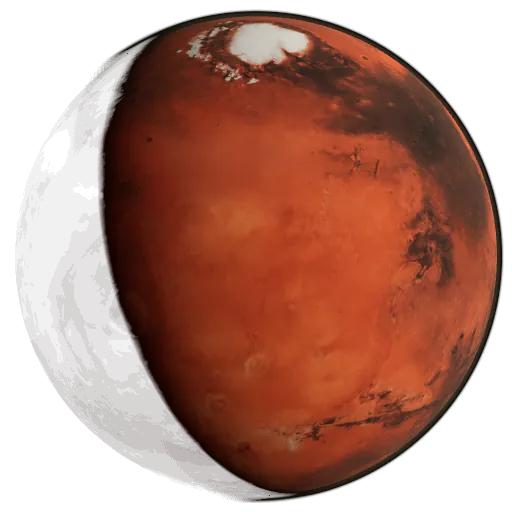
Olympus Mons rises about 22 km above the surrounding plains, roughly 2.5 times Everest, on a base about 600 km wide. Valles Marineris runs 3,870 km and reaches 9.3 km deep, about ten times the Grand Canyon in both length and depth. Polar caps of water ice wear seasonal coats of frozen CO₂.
Atmosphere and weather
The air is so thin that liquid water boils or freezes almost instantly. Even so, winds lift enough dust to raise storms that can blanket much of the planet for months.
Exploration
Perseverance has been exploring Jezero Crater's ancient delta since February 2021. In September 2025 NASA reported that its 'Sapphire Canyon' sample, from the Cheyava Falls rock, holds mineral spots that can form through microbial metabolism: a potential biosignature, though a non-biological origin is not ruled out. MAVEN's mission ended in June 2026; the twin ESCAPADE orbiters arrive in September 2027.
What we still don't know
Whether life ever arose on Mars, where its early water went, and when samples from Jezero will reach Earth for definitive tests.
Moons
The 2 major moons of Mars in the Codex, each with its own sourced entry.
Missions
- 2020–
Perseverance
NASAActiveLanded in Jezero Crater 18 Feb 2021; caching samples from an ancient river delta.
- 2011–
Curiosity
NASAActiveClimbing Mount Sharp in Gale Crater since 2012.
- 2005–
Mars Reconnaissance Orbiter
NASAActiveHiRISE camera and relay for surface missions.
- 2001–
Mars Odyssey
NASAActiveThe longest-serving spacecraft at Mars.
- 2013–2026
MAVEN
NASACompletedStudied atmospheric escape; signal lost Dec 2025 and mission end declared 3 Jun 2026.
- 2021–2024
Ingenuity
NASACompletedFirst powered flight on another planet; 72 flights.
- 2025–
ESCAPADE
NASAEn routeTwin small orbiters launched 13 Nov 2025; Mars arrival Sep 2027.
- Launch 19 Oct 2026
H3 F10 from Tanegashima at 19:41 UTC (window to 7 Nov). Phobos operations 2027–2030, sample return 2031.
First-hand · our 3D model
How we render it
Mars gets a dusty scattering shell dominated by Mie scattering from suspended dust. Its real atmosphere is so thin that the shell is thickened 1.7 times to stay visible at this scale. The globe is very slightly flattened at the poles (polar radius 0.994 of equatorial) and tilted 25.2°.
Phobos and Deimos are not spheres: each is a deterministic, displaced triaxial mesh at its measured proportions, with its long axis pointing at Mars. From the Mars view you can also see the main asteroid belt as a faint scatter of points along the ecliptic.
Sizes and distances in the model are not to scale, so every world can be seen up close. Colour maps are derived from NASA mission imagery via Solar System Scope (CC BY 4.0). The first frame uses light startup maps; higher-resolution maps stream in after the scene is on screen, decoded off the main thread so the page stays responsive.
Related entries
- PhobosMars's doomed inner moon
- DeimosMars's small, smooth outer moon
- Martian Moons eXploration (MMX)JAXA's Phobos sample return
Sources
- JPL Solar System Dynamics: planetary physical parameters (opens in a new tab)
- NASA NSSDC Mars Fact Sheet (opens in a new tab)
- NASA NSSDC Planetary Fact Sheet (opens in a new tab)
- NASA Science: Mars facts (opens in a new tab)
Last reviewed against these sources. Built from public NASA, ESA and JPL data; not affiliated with or endorsed by any agency.