
Sun & planets · Space Codex
Jupiter
More than twice as massive as all the other planets combined, Jupiter spins once every 9.9 hours.
Largest planet · gas giant
At a glance
Key points
Its magnetosphere is the largest structure in the planetary system, with a tail that reaches Saturn's orbit.
- More than twice the mass of all other planets combined
- Its magnetotail reaches Saturn's orbit
- The Great Red Spot has raged for over 300 years but is shrinking
Interior
Under the clouds, hydrogen is squeezed into a hot fluid and, deeper still, into liquid metallic hydrogen, which carries the currents that power the magnetic field. Juno's gravity measurements show the core is not a compact rocky ball but large and dilute, its heavy elements smeared across a big fraction of the planet.
Atmosphere and weather
Ammonia, ammonium hydrosulfide and water clouds stack in three decks spanning about 70 km. Jet streams alternate direction with latitude, reaching about 150 m/s. The Great Red Spot, a storm watched for more than 300 years, has shrunk from about 41,000 km wide in the late 1800s to roughly 1.2–1.3 Earth diameters today.
Magnetosphere
Jupiter's field is the strongest of any planet: 16 to 54 times Earth's at the cloud tops. Its magnetosphere extends 1–3 million km toward the Sun and its tail stretches past Saturn's orbit. Volcanic gas from Io feeds a ring of plasma that rides the field around the planet.
Exploration
Pioneer, Voyager, Galileo and Juno have all studied Jupiter. Juno, in orbit since 2016, continues on an extended mission. Europa Clipper arrives in April 2030 and ESA's JUICE in July 2031.
What we still don't know
How Jupiter's dilute core formed, how deep the jet streams reach, and why the Great Red Spot is shrinking.
Moons
The 4 major moons of Jupiter in the Codex, each with its own sourced entry.
Missions
- 1972–2003
Pioneer 10
NASACompletedFirst spacecraft to cross the asteroid belt and fly past Jupiter (1973).
- 1977–
Jupiter 1979, Saturn 1980; interstellar space since 25 Aug 2012.
- 1977–
The only spacecraft to visit Uranus (1986) and Neptune (1989); interstellar since 5 Nov 2018.
- 1989–2003
Galileo
NASACompletedFirst Jupiter orbiter (1995–2003) and first probe into a giant planet's atmosphere.
- 2011–
In Jupiter orbit since Jul 2016 on an extended mission. NASA's status page is inconsistent; perijoves are planned into 2027.
- 2024–
Launched 14 Oct 2024; Earth gravity assist 3 Dec 2026; arrives at Jupiter Apr 2030 for 49 Europa flybys.
- 2023–
Earth flyby Sep 2026, another in Jan 2029; Jupiter arrival Jul 2031, then orbit Ganymede.
First-hand · our 3D model
How we render it
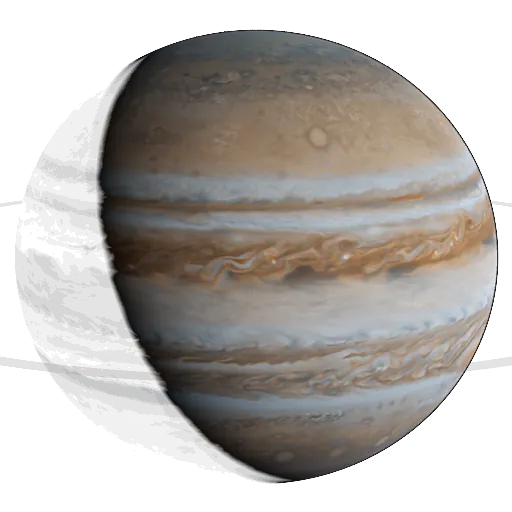
Jupiter is flattened to its real shape: the polar radius is 0.935 of the equatorial. The cloud bands are not a static picture. A zonal-flow shader advects the map so alternating jets shear the belts in opposite directions, and the Great Red Spot turns counter-clockwise, as it does in spacecraft time-lapses. A thin haze shell softens only the day-side limb, so the photographed cloud tops stay legible.
Jupiter's faint dusty rings are drawn at very low opacity, almost invisible except when backlit. The four Galilean moons orbit in Jupiter's equatorial plane with their true period ratios, so Io, Europa and Ganymede keep their 1:2:4 resonance. At full quality, Io shows the umbrella plume of its volcano Pele.
Sizes and distances in the model are not to scale, so every world can be seen up close. Colour maps are derived from NASA mission imagery via Solar System Scope (CC BY 4.0). The first frame uses light startup maps; higher-resolution maps stream in after the scene is on screen, decoded off the main thread so the page stays responsive.
Related entries
- Europa ClipperNASA's ocean-world explorer
- JUICEESA's Jupiter Icy Moons Explorer
- JunoNASA's Jupiter polar orbiter
Sources
- JPL Solar System Dynamics: planetary physical parameters (opens in a new tab)
- NASA NSSDC Planetary Fact Sheet (opens in a new tab)
- NASA NSSDC Jupiter Fact Sheet (opens in a new tab)
- NASA Science: Jupiter facts (opens in a new tab)
- NASA Science: Jupiter moons (opens in a new tab)
- ESA: Hubble heic1410 (opens in a new tab)
Last reviewed against these sources. Built from public NASA, ESA and JPL data; not affiliated with or endorsed by any agency.