
Phenomena · Space Codex
Black hole
A region where spacetime curves so steeply that nothing, not even light, can climb back out past the event horizon.
Event horizon · gravity light cannot escape
At a glance
Key points
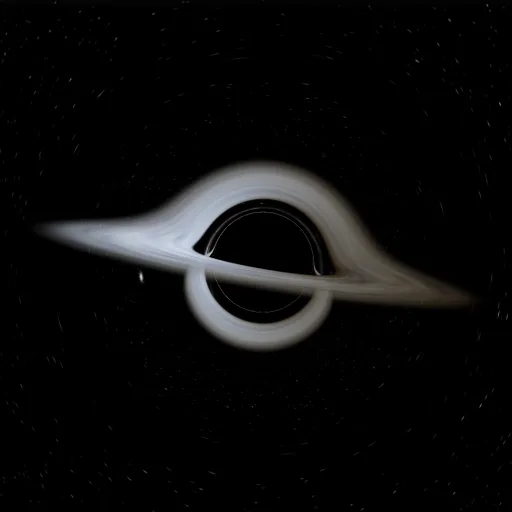
What we see is the hot gas swirling outside it, bent into a ring around a dark shadow.
- Stable orbits exist outside the horizon: black holes are not cosmic vacuum cleaners
- The dark shadow is about 2.6 times wider than the horizon
- Near Sgr A*, six hours of orbiting costs you 36 minutes of ageing
What you would see
Light from the far side of a disc of hot gas is bent over and under the shadow, so the disc appears to wrap around the black hole. Thin, nested photon rings hug the shadow's edge, made by light that looped the hole once or more. Gas on the side moving toward you is brightened and shifted bluer; the receding side dims.
On the screen
Interstellar's black hole used a disc at a uniform 4,500 K and deliberately left out the Doppler brightening, which made the true image too lopsided for the film. A real thin disc around a stellar-mass hole would glow mostly in X-rays; the orange of EHT images is a false-colour map of radio brightness.
Size matters
Tides are strongest near small black holes: a stellar-mass hole would stretch you apart well outside its horizon. A supermassive one, above about 100 million Suns, would let you cross the horizon intact and swallow a Sun-like star whole.
What we still don't know
What happens at the centre, where general relativity predicts a singularity, and whether information that falls in is ever released by Hawking radiation.
Missions
- 2017–
Event Horizon Telescope
International collaborationActiveEarth-sized radio interferometer at 1.3 mm; imaged M87* (2019) and Sgr A* (2022).
- 2015–
LIGO–Virgo–KAGRA
NSF / EGO / NAOJActiveO4 ran 24 May 2023 – 18 Nov 2025; a six-month run (IR1) is due to start in late 2026.
First-hand · our 3D model
How we render it
The black hole is ray-traced live on your GPU. For every pixel near the hole, a shader follows a light ray backwards along an exact Schwarzschild null geodesic, in 150 steps at full quality and 96 at reduced quality (rendered at half resolution). That produces the dark shadow at about 2.6 Schwarzschild radii, the thin photon ring around it, and the far side of the disc lensed over and under the shadow.
The disc runs from the innermost stable orbit at 3 Schwarzschild radii out to 12, with Keplerian shear, so the inner disc visibly outpaces the outer. Its temperature follows the Novikov-Thorne profile, display-scaled to a 9,000 K peak, and colour shifts use the exact redshift factor including gravitational redshift. Doppler beaming is softened (g³ instead of g⁴), which is why the approaching side looks blue-white and the receding side warm rather than film-orange. The lensed background is the real Milky Way panorama.
Related entries
- Sagittarius A*The black hole at the centre of the Milky Way
- M87*The first black hole ever imaged
- Gravitational wavesRipples in spacetime
- What is a black hole?Gravity so strong light cannot escape
Sources
- James, von Tunzelmann, Franklin & Thorne 2015, CQG 32:065001 (arXiv) (opens in a new tab)
- ESO: eso1907: first image of a black hole (opens in a new tab)
- ESO: eso2208: first image of Sgr A* (opens in a new tab)
- NASA Science: Black hole visualization beyond the brink (opens in a new tab)
- ESA: Gaia BH3 (opens in a new tab)
Last reviewed against these sources. Built from public NASA, ESA and JPL data; not affiliated with or endorsed by any agency.